
In the fleet industry, nearly everything hinges on commercial vehicles, especially deliveries, customer experience, overall efficiency, and productivity.
Unexpected downtime hits fleets of every size. This makes vehicle readiness a priority for maintenance teams at small and medium-sized businesses as much as at large firms.
Our guide to commercial fleet management covers the maintenance services and planning practices that keep your vehicles road-ready and your business on schedule.
Why Commercial Fleet Management Matters to Your Business
Whether you manage a handful of vehicles or a fleet running across multiple states, commercial vehicles face the same set of problems.
Mid-Route Breakdowns A brake failure or a damaged tire leaves a vehicle stranded mid-route. Each one means a stalled driver, a delayed load, and an unplanned repair bill.
Harsh Weather Conditions Extreme heat, freezing temperatures, and heavy rain put extra strain on tires, batteries, and brakes. Worn components are usually the first to fail under those conditions.
Customer Delivery Commitments A vehicle out of service throws off delivery schedules and customer appointments. The cost reaches customer trust as well as revenue.
Regulatory Compliance Commercial vehicles need regular inspections, safety checks, and maintenance records to meet transport regulations. A missed inspection or an unresolved defect can lead to penalties and vehicle restrictions.
Asset Lifecycle Management Without a clear record of maintenance history, repair costs, and mileage, the decision to keep or replace a vehicle becomes guesswork. Long-term ownership costs then climb without anyone noticing.
To overcome these challenges, you need a mix of on-site fleet management and mobile fleet maintenance.
Essential Services for Your Fleet Maintenance Plan
Small and medium-sized businesses need a maintenance plan that covers routine servicing, roadside help, inspections, and emergency repair management.
But the right mix of services depends on their fleet size, vehicle type, routes, and service commitments.
The services listed below form the foundation.
Preventive Maintenance Scheduled oil changes, filter replacements, and fluid checks catch wear while it is still a small job. That keeps it from growing into a major repair.
Mobile Fleet Maintenance Technicians service vehicles at your premises or yard, so routine work no longer means a trip to a repair facility.
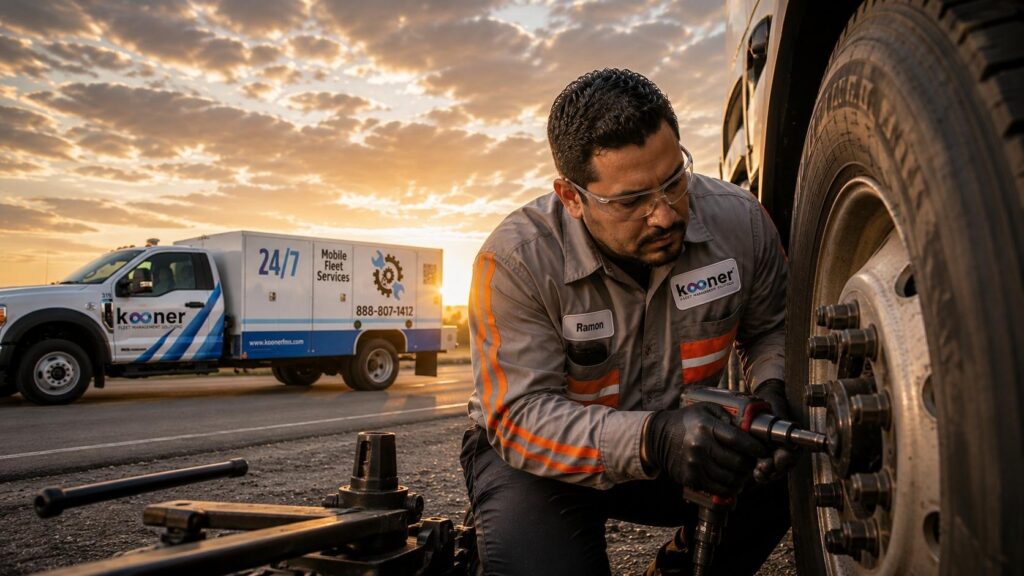
Roadside Assistance and Mobile Repairs A technician can reach a vehicle with a mechanical fault or damaged tire and repair it where it stopped, instead of leaving it to wait for a tow.
DOT and Safety Inspections Regular inspections and defect checks, backed by compliance records, show that your vehicles are roadworthy and meet the regulations that apply to you.
Diagnostics and Vehicle Health Monitoring Diagnostic tools read fault codes and flag vehicle health concerns. Those findings show which repairs cannot wait and which can join the next scheduled service.
Tire and Brake Maintenance Tread depth, tire pressure, and braking performance have a direct effect on safety. Routine checks catch wear and defects before the vehicle goes back out.
If you’re managing long-haul operations and heavy-duty trucks, invest in mobile fleet maintenance. And if you’re managing light-duty delivery vehicles, last-mile fleet maintenance is a must.
Fleet Management Services to Add as Your Business Expands
As you scale, your maintenance needs will move past one-off repairs. More vehicles, longer routes, and extra service commitments need proactivity than reactive repairs.
Services that will support business expansion:
Fleet Management Software and Telematics Vehicle tracking, mileage records, and fault alerts show how each vehicle is used. Service reminders tell you when one is due for maintenance.
Maintenance Cost Tracking Service records and repair invoices, broken down by vehicle, show where your maintenance budget goes. That gives you a firm basis for deciding how often to repair a vehicle and when to replace it.
Fuel Management Fuel consumption records and idle-time monitoring point out excessive fuel use so you can keep costs under control.
Fleet Lifecycle Planning A vehicle’s age, mileage, and repair history, set against its projected maintenance costs, tell you when to replace it. You can then plan the capital spending well ahead.
Centralized Maintenance Coordination One point of contact for service requests, repair updates, inspections, and records keeps coordination simple as vehicles and service locations multiply.
The objective is to limit reacting to problems and plan maintenance.
Kooner Fleet Management Solutions: One Partner for All Your Fleet Maintenance Needs
Every service in this guide, from preventive maintenance and roadside repair to DOT inspections, can come from a single partner.
For small and medium-sized businesses, Kooner Fleet Management Solutions offers mobile fleet services that bring technicians to your yard or to the breakdown location, so your vehicles stay in service without a trip to a repair facility. For large operations, we provide on-site fleet management, with our team working inside your facility to handle daily maintenance and inspections.
Our platform, FleetIQ, ties it together by keeping service requests, dispatch, and predictive maintenance tracking in one place.